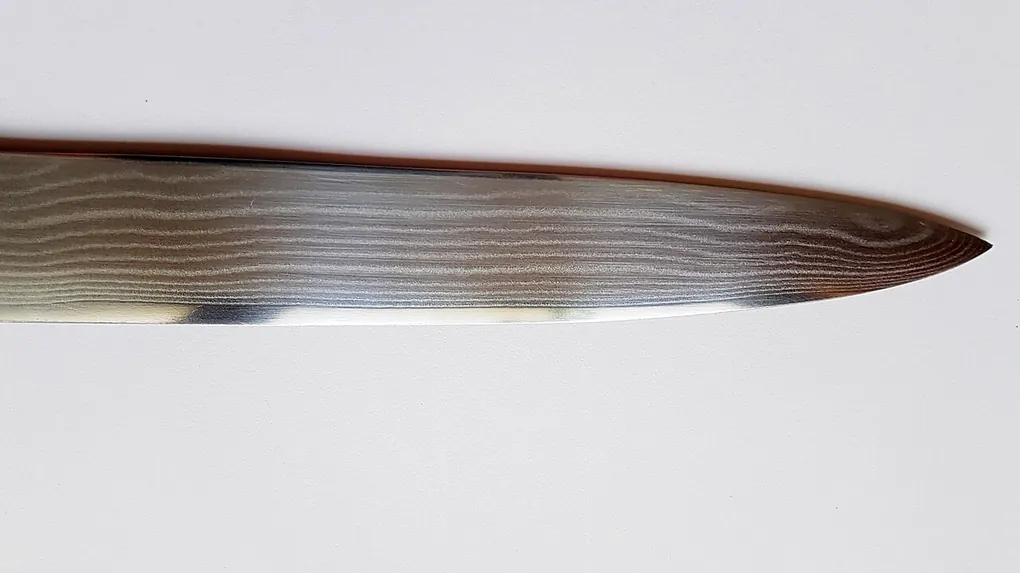
Short answer: A modern Damascus knife is usually made from pattern-welded steel: two or more types of steel are stacked, forge-welded together, folded or twisted into many layers, then etched in acid so the different steels show up as a flowing, wood-grain or water-like pattern. The name comes from the legendary historic Damascus steel swords of the Middle East, which were made in a different way, from crucible “wootz” steel, using a method that was later lost.
The pattern itself does not make a knife sharper. What matters is the quality of the steels, the heat treatment and the edge geometry. Many good Damascus kitchen knives have a hard core steel at the edge wrapped in decorative Damascus layers. A well-made Damascus knife can be excellent; a cheap one can be soft steel with a printed or etched pattern. Buy from reputable makers, hand wash and dry it, and sharpen it on whetstones.
Few objects in a kitchen draw as many admiring looks as a Damascus knife. The rippling pattern across the blade looks like flowing water, wood grain or smoke, and it carries an air of ancient craft and legend. It also raises questions: is it real Damascus, is it better than ordinary steel, how do you look after it, and is it worth the price? This guide explains the history behind the name, how modern Damascus is made, the patterns you will see, how Damascus kitchen and pocket knives perform, how to spot fakes, and how to care for and sharpen yours so it stays beautiful for decades.

Historic Damascus steel: the legend
For centuries, swords made from what Europeans called Damascus steel had a reputation for toughness, sharpness and a striking watered pattern. They were associated with the Middle East, particularly the trading city of Damascus in Syria, although the name’s origin is debated: it may refer to the city, or to the Arabic word for the watered pattern.
The steel itself is believed to have come mainly from South Asia, particularly southern India and Sri Lanka, in the form of small cakes of crucible steel known as wootz. Smiths forged these cakes into blades at carefully controlled temperatures, and the pattern emerged from bands of hard carbide particles within the steel rather than from welding layers together. Knowledge of how to make true wootz Damascus blades appears to have died out by around the 18th to 19th century, possibly because the specific ores with the right trace elements ran out and the skills were not passed on.
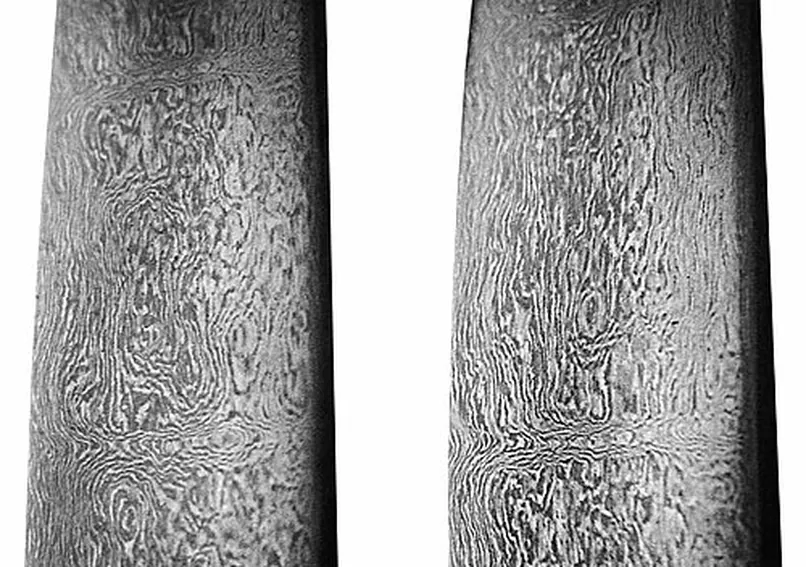
Modern science has helped unravel the mystery. In the 1990s, metallurgist John Verhoeven and bladesmith Alfred Pendray reproduced wootz-style patterns and showed that small amounts of trace elements, such as vanadium, played a key role in forming the carbide bands. In 2006, researchers in Dresden reported in the journal Nature that they had found carbon nanotubes and cementite nanowires in a 17th-century Damascus sabre, suggesting the old smiths were unknowingly using nanoscale structures.
- AncientCrucible (wootz) steel is produced in South Asia and traded widely.
- Early medievalPattern welding is used in Europe, including Migration-era and Viking swords.
- MedievalDamascus blades from the Middle East gain a legendary reputation.
- 18th–19th c.Production of true wootz Damascus blades fades out.
- 1970s onwardsBladesmiths revive pattern welding for knives, now widely called “Damascus”.
- 1990sVerhoeven and Pendray reproduce wootz patterns in the laboratory.
- 2006Nanostructures are reported in a historic Damascus sabre (Nature).
Modern Damascus: pattern-welded steel
Almost every Damascus knife sold today is made by pattern welding, a different technique with an equally long history. Instead of one crucible steel, the smith uses two or more contrasting steels, often a high-carbon steel and a nickel-rich steel, which etch to different shades.
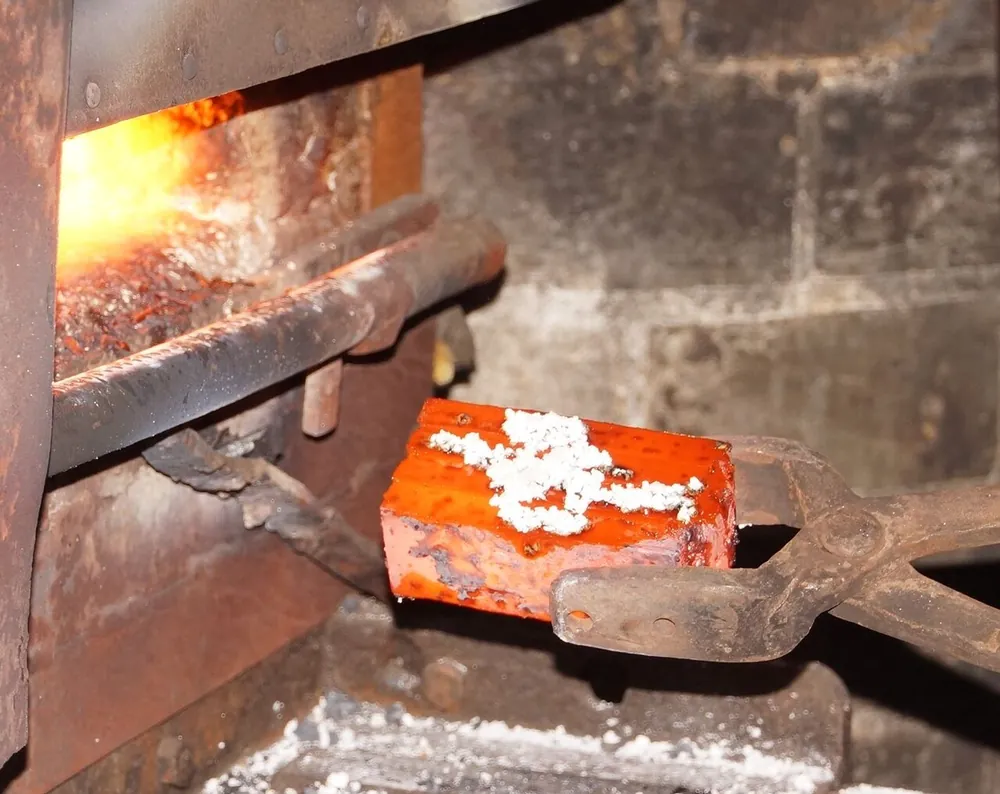
Because the layers multiply with each fold, layer counts rise quickly. A billet that starts with a dozen or so layers can reach several hundred after a handful of folds. More layers produce a finer pattern, but more is not automatically better: very high layer counts can blur into a near-uniform look, and every weld is a potential weak point if done poorly.
Common Damascus patterns
| Pattern | How it is made | Look |
|---|---|---|
| Random | Simple folding without deliberate manipulation | Organic, wood-grain swirls |
| Ladder | Grooves cut or pressed across the billet, then ground flat | Rungs running across the blade |
| Raindrop | Shallow holes drilled or pressed, then ground flat | Rings or droplets across the blade |
| Twist | The bar is heated and twisted, then flattened | Star or chevron patterns |
| Feather | The billet is split with a wedge and forged | A feather-like centre line |
| Mosaic | Pre-arranged pieces are welded into a picture | Repeating images or complex designs |
Clad Damascus kitchen knives
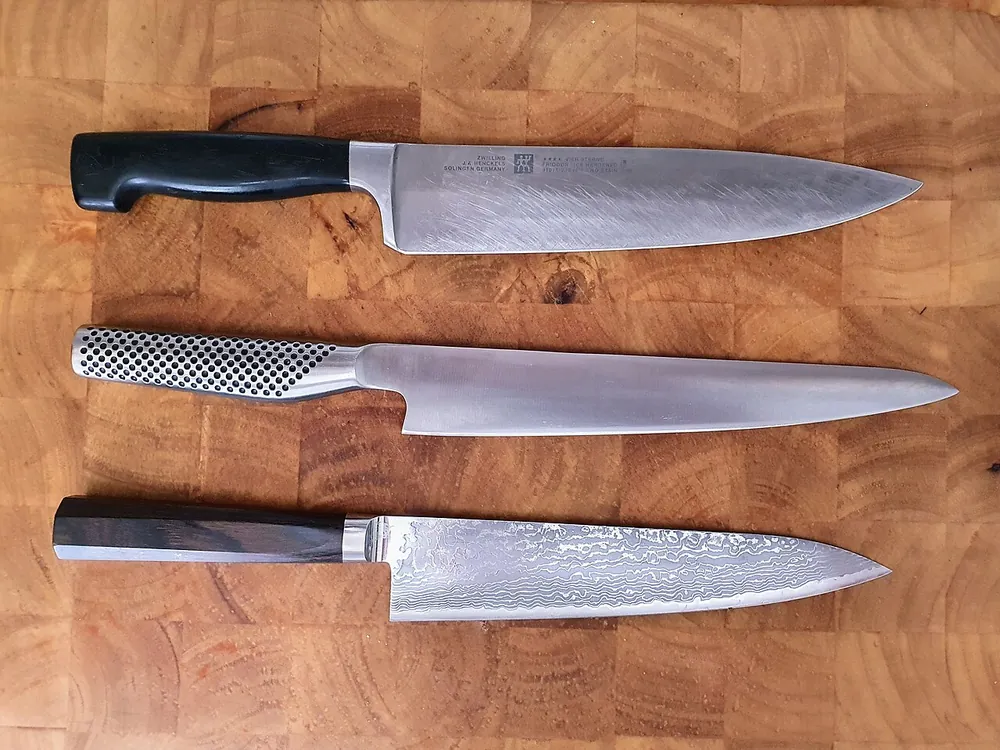
Many Damascus kitchen knives, especially Japanese-style ones, are built differently from a fully pattern-welded blade. They use a hard core steel, such as VG-10, AUS-10 or a powdered steel like SG2, for the cutting edge, and wrap it in layers of softer Damascus cladding on each side. This is sometimes called san-mai (three-layer) construction.
| Construction | What cuts | Notes |
|---|---|---|
| Fully pattern-welded | The Damascus layers themselves | Performance depends on both steels and the welds |
| Clad (san-mai style) | A single hard core steel at the edge | Damascus layers are mostly decorative and protective |
| Printed or etched-on pattern | A plain steel blade | The pattern is surface decoration only |
In a clad knife, the cutting performance comes from the core steel, which is usually hardened to a high level, while the softer cladding makes the blade tougher and easier to sharpen. That makes the core steel the most important thing to check when you compare clad Damascus knives.
Is Damascus better than ordinary steel?
Honestly, not automatically. The pattern is beautiful, and a well-made Damascus blade can perform superbly, but a plain blade made from a good modern steel with an excellent heat treatment will cut just as well. The real drivers of performance are the same for every knife:
| Factor | Why it matters |
|---|---|
| Steel type | Determines edge retention, toughness and corrosion resistance |
| Heat treatment | Sets hardness and toughness; poor heat treatment ruins good steel |
| Hardness (HRC) | Higher hardness holds an edge longer but can chip more easily |
| Edge geometry | A thin edge cuts more easily; a thicker one is tougher |
| Weld quality (pattern-welded) | Poor welds can cause flaws or delamination |
| Fit and finish | Handle, balance and comfort affect everyday use |
My advice: buy a Damascus knife because you love the look and the craft, and choose one from a maker who tells you exactly which steels are used, how hard the edge is, and how it was heat-treated. That information matters far more than the number of layers.
How to spot fake Damascus
Because Damascus sells at a premium, many cheap knives imitate the look. Some use a laser-etched or printed pattern on a plain blade; others are genuine pattern-welded steel but made from low-grade steels with poor heat treatment.
Note that a sharpened edge on genuine Damascus may look slightly lighter where the etched surface has been ground away. That is normal. But if the pattern seems to float on the surface like a picture, rubs off, or appears only on one side, be suspicious.
Damascus pocket and outdoor knives
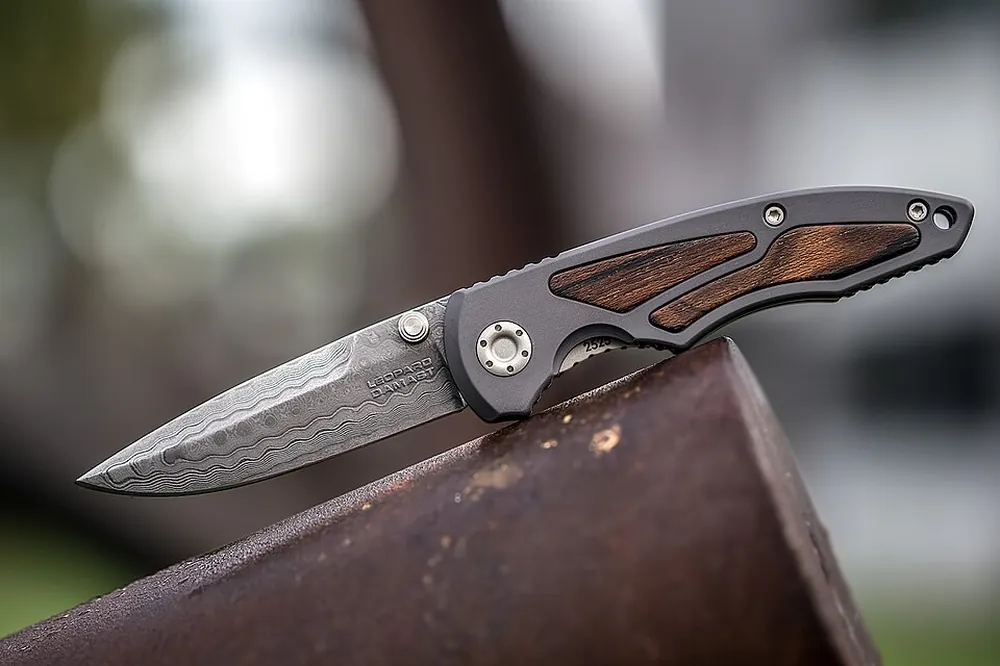
Damascus is popular for pocket knives, hunting knives and collectors’ pieces, where the pattern adds to the appeal. For outdoor use, toughness and corrosion resistance often matter more than extreme hardness. Some Damascus is made from stainless steels and resists rust well; carbon-steel Damascus needs more care, particularly in wet conditions.
| Type of Damascus | Pros | Cons |
|---|---|---|
| Carbon-steel Damascus | High contrast pattern, easy to sharpen, traditional | Rusts easily; develops patina; needs oiling |
| Stainless Damascus | Better corrosion resistance; lower maintenance | Pattern may be less contrasting; can be pricier |
| Clad stainless with hard core | Excellent edge with low maintenance | Core steel quality varies by brand |
Caring for a Damascus knife
Good care keeps the pattern crisp and the edge sharp. The rules are simple but important, especially for carbon-steel Damascus.
- Hand wash only. Dishwashers expose the blade to heat, harsh detergents and knocks that dull edges, damage handles and can cause corrosion.
- Dry immediately. Wipe the blade dry straight after washing; never leave it wet in a sink or on a draining board.
- Oil carbon steel. A thin coat of food-safe oil, such as camellia or mineral oil, protects against rust between uses.
- Wipe off acidic foods. Citrus, tomatoes and onions can stain or dull the etch if left on the blade.
- Use a good board. Wood or soft plastic boards are kind to edges; avoid glass, stone and ceramic.
- Store safely. Use a knife block, magnetic strip or blade guard, not loose in a drawer.
Sharpening and honing
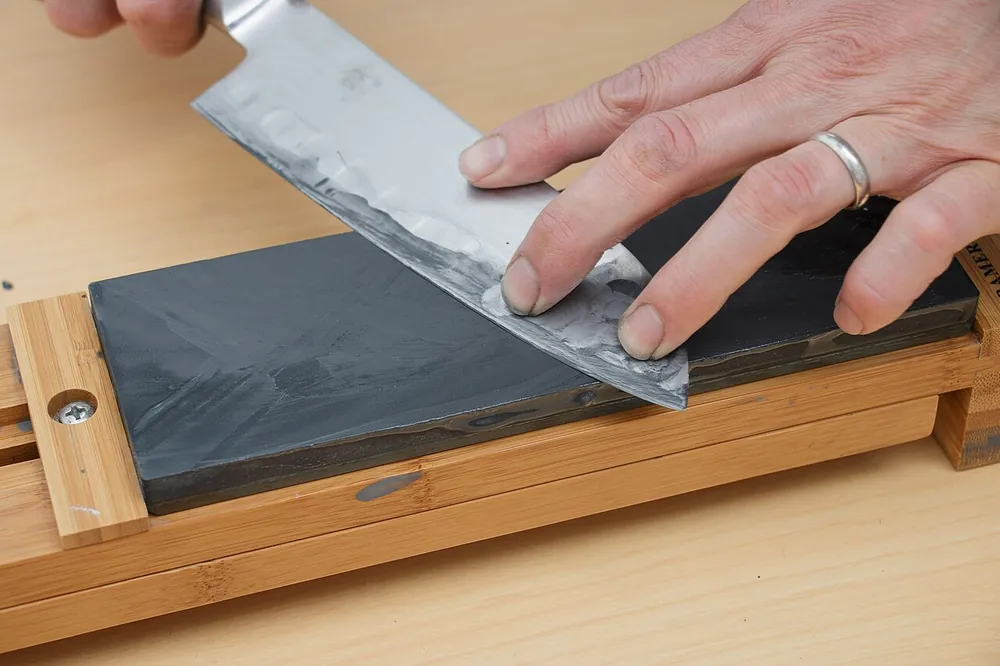
Damascus knives are sharpened like any other knife of the same steel. Whetstones give the best control and are the method most makers recommend. Pull-through carbide sharpeners can remove metal aggressively and leave a rough edge, so they are best avoided on fine knives.
| Tool | Use | Notes |
|---|---|---|
| Coarse whetstone (about 200–600 grit) | Repairing chips or a very dull edge | Used only occasionally |
| Medium whetstone (about 1000 grit) | Regular sharpening | The workhorse stone |
| Fine whetstone (3000–8000 grit) | Refining and polishing the edge | Gives a very keen edge |
| Ceramic honing rod | Realigning the edge between sharpenings | Gentler than steel rods on hard blades |
| Leather strop | Final polish and burr removal | Optional but helpful |
Many Japanese-style knives are sharpened at a narrower angle than traditional Western knives, often around 15 degrees per side compared with about 20 degrees, but check your maker’s guidance. Hold a steady angle, use light pressure, and work evenly along the edge. If you are not confident, a professional sharpening service is a good investment for a valuable knife.
Choosing a Damascus knife
| If you want | Look for |
|---|---|
| An everyday kitchen workhorse | A clad chef’s knife or gyuto with a named hard core steel |
| Low maintenance | Stainless Damascus or stainless cladding |
| Maximum pattern contrast | Carbon-steel Damascus from a skilled maker |
| A gift or collector’s piece | A handmade blade from a recognised bladesmith |
| Outdoor use | A tough steel, a secure handle and a good sheath |
Prices range from inexpensive factory knives to handmade pieces costing many times more. As a rule, the more a seller tells you about the steels, heat treatment and maker, the more confidence you can have. A Damascus knife also makes a memorable gift, especially around the holidays; just check the recipient’s age and local laws.
Damascus myths worth ignoring
| Myth | Reality |
|---|---|
| More layers always means a better knife | Layer count changes the look; steel choice and heat treatment decide performance |
| Damascus never needs sharpening | Every edge dulls with use; Damascus is sharpened like any other knife |
| All Damascus is hand-forged by a single smith | Much Damascus is factory-made from pre-produced layered sheet steel |
| The pattern is a coating | On genuine Damascus it runs through the steel; only imitations are surface-printed |
| Old swords could cut through anything | Historic blades were excellent for their time, but legends grew in the retelling |
| Damascus cannot rust | Carbon-steel Damascus rusts easily; even stainless needs drying |
None of this takes away from the appeal. Factory-made Damascus sheet steel has made the look affordable, while independent bladesmiths continue to forge their own billets and push the craft forward with ever more intricate mosaic and twist patterns. Both can produce excellent knives. The key is honesty about what you are buying: a clear description of the steels, whether the blade is clad or fully pattern-welded, and the hardness of the edge. A maker who is open about those details is usually one who takes pride in the result.
Knife laws: a note for UK readers
In the UK, it is an offence to carry a bladed article in public without good reason or lawful authority, with an exception for folding pocket knives whose cutting edge is 3 inches (7.62 cm) or less and which do not lock. Locking knives are not covered by that exception. It is also illegal to sell a knife to anyone under 18, with limited exceptions in Scotland. Kitchen knives are legal to own at home, but carrying one in public needs a good reason, such as taking it to work as a chef. Check GOV.UK for current rules, as knife laws are updated from time to time. In the US, knife laws vary widely by state and city.
More home and garden guides: how to preserve roses, fun hobbies for outdoorsy people, what dreams mean, how long AC units last, mini splits in older homes, fixing drafty windows, 9 vs 10 foot Christmas trees.
Frequently asked questions
What is a Damascus knife?
Usually a knife made from pattern-welded steel: layers of different steels forge-welded, folded and etched to reveal a flowing pattern.
Is modern Damascus the same as historic Damascus steel?
No. Historic Damascus blades were made from crucible (wootz) steel; modern Damascus is mostly pattern-welded steel.
Are Damascus knives sharper?
Not automatically. Sharpness and edge retention depend on the steel, heat treatment and edge geometry, not the pattern.
Why do Damascus knives have a pattern?
The different steels etch differently in acid, showing the layers as light and dark bands.
How can I tell if Damascus is real?
Check that the pattern runs through the spine and edge, read the steel specifications, and buy from reputable makers.
Do Damascus knives rust?
Carbon-steel Damascus can rust easily; stainless Damascus resists rust better. Dry and oil carbon blades.
Can Damascus knives go in the dishwasher?
No. Hand wash and dry them immediately to protect the edge, handle and pattern.
How do I sharpen a Damascus knife?
Use whetstones at the maker’s recommended angle, and hone with a ceramic rod between sharpenings.
How many layers should a Damascus knife have?
There is no ideal number. Layer count affects the look more than performance.
Is it legal to carry a Damascus knife in the UK?
Only if it is a non-locking folding knife with a cutting edge of 3 inches or less, unless you have a good reason.
Final thoughts
A Damascus knife combines centuries of blacksmithing history with modern metallurgy. Understand what you are buying: a pattern-welded or clad blade, which steels, and how it was heat-treated. Choose a reputable maker, hand wash and dry it, sharpen it on stones, and your Damascus knife will be both a beautiful object and a superb tool for many years.
Sources: Reibold, M. et al., “Carbon nanotubes in an ancient Damascus sabre”, Nature (2006); J. D. Verhoeven, A. H. Pendray and colleagues on wootz Damascus steel; museum collections on pattern-welded and wootz blades; knife makers’ care and sharpening guidance; GOV.UK guidance on buying and carrying knives. Images: Wikimedia Commons, credited in each caption.