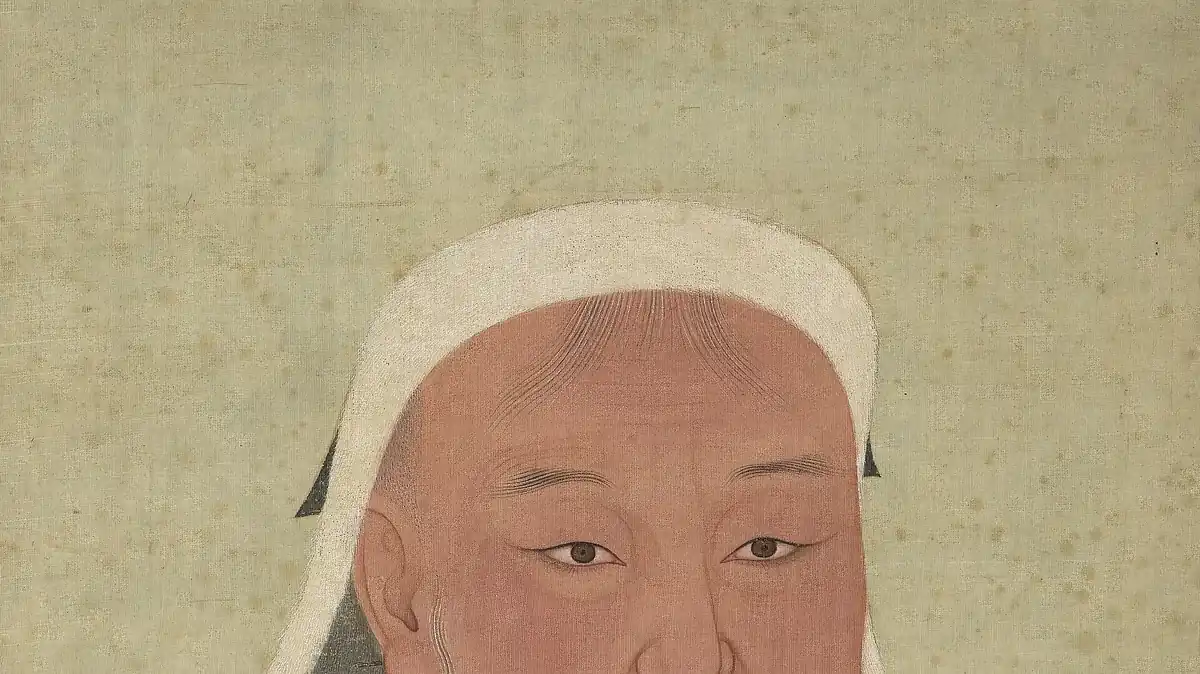
Short answer: Genghis Khan (born Temüjin, c. 1162-1227), also spelled Chinggis Khan, was the founder and first ruler of the Mongol Empire. After uniting the feuding tribes of the Mongolian steppe, he took the title Genghis Khan in 1206 and launched campaigns that conquered much of northern China and Central Asia. Under his successors the empire became the largest contiguous land empire in history.
He remains deeply controversial: his armies killed millions and devastated whole regions, yet his empire also opened trade and cultural exchange across Eurasia. In Mongolia he is honoured as the founding father of the nation; in Russia and much of the Middle East he is remembered as a destroyer.
I will be honest with you: Genghis Khan is one of history’s hardest figures to sum up fairly. Popular culture swings between two caricatures, the bloodthirsty barbarian and the misunderstood genius of global trade. The real story is more interesting than either: a boy abandoned to near-starvation who rebuilt Mongol society from the ground up, created one of the most effective armies the world has seen, and left a legacy that still shapes Asia today. Here is who he was, what he did and why he still matters.

Genghis Khan: quick facts
| Details | |
|---|---|
| Birth name | Temüjin |
| Born | c. 1162 (estimates range from 1155 to 1167), Mongolian steppe |
| Died | 18 or 25 August 1227, during a campaign against the Western Xia |
| Title | Genghis (Chinggis) Khan, adopted in 1206 |
| Father | Yesugei, a chieftain of the Borjigin clan |
| Mother | Hö’elün |
| Principal wife | Börte |
| Sons with Börte | Jochi, Chagatai, Ögedei and Tolui |
| Successor | His third son, Ögedei (from 1229) |
| Famous grandson | Kublai Khan, founder of China’s Yuan dynasty |
What does “Genghis Khan” mean?
“Khan” means ruler. The meaning of “Genghis”, or “Chinggis” in modern Mongolian transliteration, is uncertain. Some scholars connect it to a word for “ocean”, suggesting a universal ruler; others link it to words meaning “firm”, “fierce” or “unwavering”. What is clear is that it was a title, not a name: he was born Temüjin and took the title at an assembly of Mongol leaders in 1206.
| Spelling | Where you see it |
|---|---|
| Genghis Khan | Traditional English spelling |
| Chinggis Khaan | Modern Mongolian transliteration, used in Mongolia |
| Jenghiz / Chingis | Older or alternative spellings |
Early life: from outcast to leader
Temüjin was born on the steppe of what is now Mongolia, the eldest child of Yesugei, a chieftain of the Borjigin clan, and his wife Hö’elün. When he was about eight, his father died, reportedly poisoned by rivals, and his family was abandoned by its tribe. Hö’elün and her children survived in near-poverty by foraging and fishing. In this period, Temüjin killed his older half-brother, Behter, in a dispute that secured his own position in the family, an episode recorded in The Secret History of the Mongols.
His charisma began to attract followers, and he formed alliances with two powerful steppe leaders: his sworn brother (anda) Jamukha, and Toghrul, ruler of the Kerait tribe and a former ally of his father. Together they rescued Temüjin’s young wife, Börte, who had been kidnapped by raiders from the Merkit tribe.
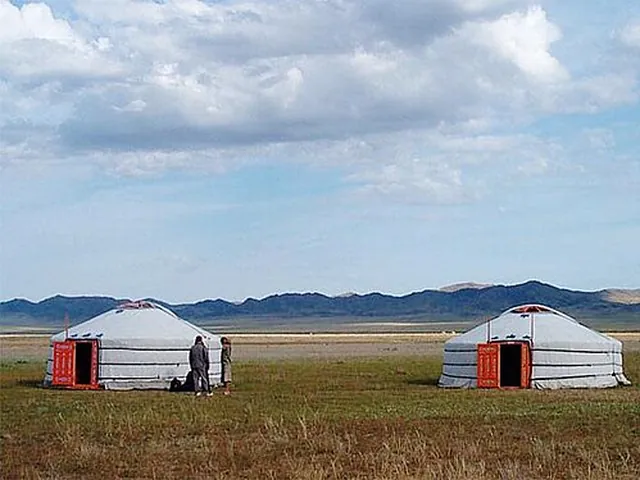
As his reputation grew, his friendship with Jamukha turned into rivalry and then open war. Temüjin was badly defeated around 1187 and may have spent the following years as a subject of China’s Jin dynasty. When he re-emerged in 1196, his rise was rapid. Toghrul came to see him as a threat and attacked in 1203, but Temüjin regrouped and defeated him. After crushing the Naiman tribe and executing Jamukha, he stood as the sole ruler of the Mongolian steppe.
Börte and the family he built
Börte, betrothed to Temüjin as a child, was his principal wife and one of his most trusted advisers. Her kidnapping by the Merkit tribe, and her rescue, was a turning point in his early career, cementing his alliances with Jamukha and Toghrul. Her first son, Jochi, was born soon after her return, and questions about his paternity followed him all his life, shaping the later rivalry among Genghis’s sons. Börte’s four sons, Jochi, Chagatai, Ögedei and Tolui, became the founders of the dynasties that ruled the empire. Genghis’s mother, Hö’elün, who had kept the family alive after his father’s death, also remained an influential figure.
1206: the birth of the Mongol Empire
In 1206, at a great assembly (kurultai) of steppe leaders, Temüjin was proclaimed Genghis Khan. He then set about rebuilding Mongol society to end the endless tribal feuding that had shaped his childhood.
| Reform | What it did | Why it mattered |
|---|---|---|
| Decimal army | Organised fighters in units of 10, 100, 1,000 and 10,000 | Broke up tribal loyalties and enabled fast, coordinated command |
| Merit over birth | Promoted commanders for loyalty and ability, not lineage | Created a loyal, capable elite |
| Yassa | A code of laws and decrees governing Mongol society and the army | Imposed order across a growing empire |
| Writing | Adopted the Uyghur script to write Mongolian | Allowed records, laws and administration |
| Yam relay system | A network of relay stations with fresh horses for messengers | Fast communication across vast distances |
| Religious tolerance | Generally allowed conquered peoples to keep their faiths | Reduced resistance; welcomed advisers of many backgrounds |
My advice, if you want to understand how a small population of nomads conquered so much: start with these reforms rather than the battles. The decimal army and merit-based promotion turned rival clans into a single, highly mobile force, and the relay system let orders travel faster than any rival’s.
The conquests
- 1209-1210Raids the Western Xia kingdom in north-west China, which accepts Mongol terms.
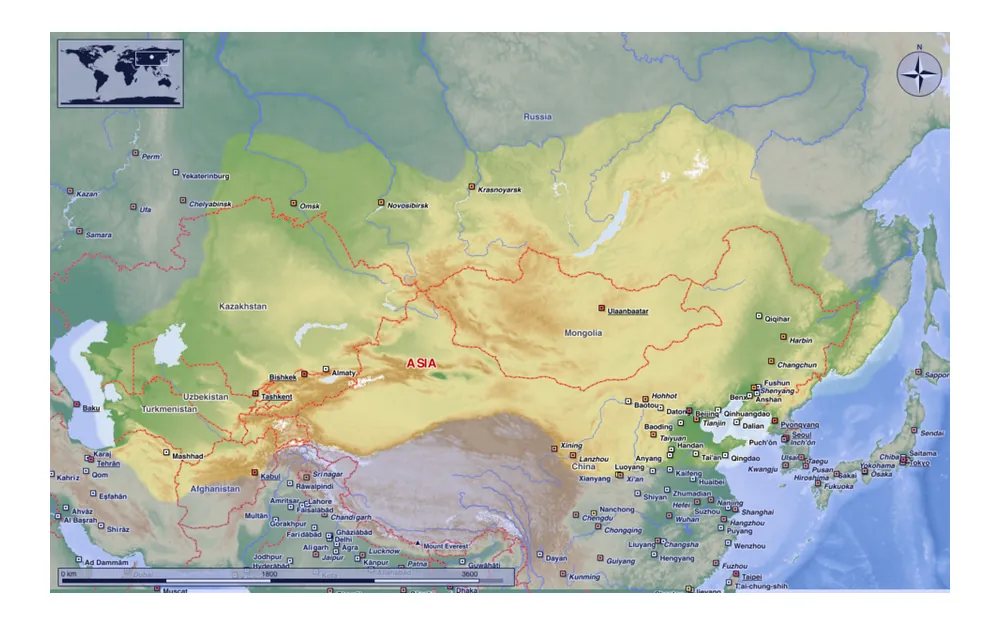
- 1211-1215Campaign against the Jin dynasty in northern China; the Jin capital Zhongdu (near modern Beijing) falls in 1215.
- 1218His general Jebe annexes the Central Asian state of Qara Khitai.
- 1219-1221After his envoys are executed, invades the Khwarazmian Empire, devastating Transoxiana and Khorasan.
- 1221-1223Generals Jebe and Subutai lead a reconnaissance expedition through the Caucasus, reaching Georgia and the lands of Kievan Rus’.
- 1227Dies while suppressing a rebellion by the Western Xia.
The war against the Khwarazmian Empire, centred on today’s Uzbekistan, Turkmenistan and Iran, was the most destructive. Genghis had sought trade relations; when a Khwarazmian governor massacred a Mongol trade caravan and the shah executed his envoys, he responded with overwhelming force. Great cities such as Bukhara, Samarkand, Urgench and Merv were sacked, and contemporary chroniclers described enormous loss of life. Modern historians debate the exact numbers, but the devastation of the region was real and long-lasting.
How the Mongol army won
- Horse archers: every warrior was a skilled rider and archer, often with several horses to change between.
- Speed: armies could cover great distances quickly, surprising enemies.
- Discipline: the decimal system and strict rules kept units coordinated.
- Tactics: feigned retreats, encirclement and coordinated attacks from several directions.
- Intelligence: scouts, spies and merchants gathered information before campaigns.
- Siege engineering: captured Chinese and Persian engineers built siege machines to take walled cities.
- Terror: cities that resisted were often destroyed, encouraging others to surrender.
How do we know about Genghis Khan?
Much of what we know comes from a handful of medieval sources, each with its own perspective:
| Source | Written by | Perspective |
|---|---|---|
| The Secret History of the Mongols | An anonymous Mongol author, 13th century | An insider account for the Mongol court; the main source for his early life |
| History of the World Conqueror | Ata-Malik Juvayni, a Persian official in Mongol service | Detailed but written for Mongol rulers, while describing the destruction vividly |
| Compendium of Chronicles | Rashid al-Din, a Persian vizier of the Ilkhanate | A vast world history drawing on Mongol records |
| History of Yuan (Yuanshi) | Chinese court historians of the Ming dynasty | An official dynastic history from the Chinese perspective |
Because the earliest detailed account comes from a Mongol court chronicle, and much of the rest from historians writing for Mongol rulers or for their enemies, scholars treat numbers and dramatic stories with caution. Casualty figures in particular vary enormously between sources.
Death and burial
Genghis Khan died in August 1227 (sources give the 18th or the 25th) while campaigning against the rebellious Western Xia. The cause is uncertain: accounts mention a fall from his horse, illness or wounds. Following his wishes, he was buried in secret, and the location of his grave has never been found, despite modern searches. Tradition holds that it lies somewhere near the sacred mountain of Burkhan Khaldun in northern Mongolia.
After a two-year interregnum, his third son, Ögedei, became Great Khan in 1229, as Genghis had chosen. His other sons and their descendants ruled different parts of the empire.
His family and the empire after him
| Descendant | Relationship | Known for |
|---|---|---|
| Jochi | Eldest son | His descendants ruled the Golden Horde in Russia and the steppe |
| Chagatai | Second son | Gave his name to the Chagatai Khanate in Central Asia |
| Ögedei | Third son | Succeeded as Great Khan in 1229; oversaw the invasion of Europe |
| Tolui | Youngest son | Father of Möngke, Kublai and Hülegü |
| Kublai Khan | Grandson | Conquered all of China and founded the Yuan dynasty (1271) |
| Hülegü | Grandson | Founded the Ilkhanate in Persia; sacked Baghdad in 1258 |
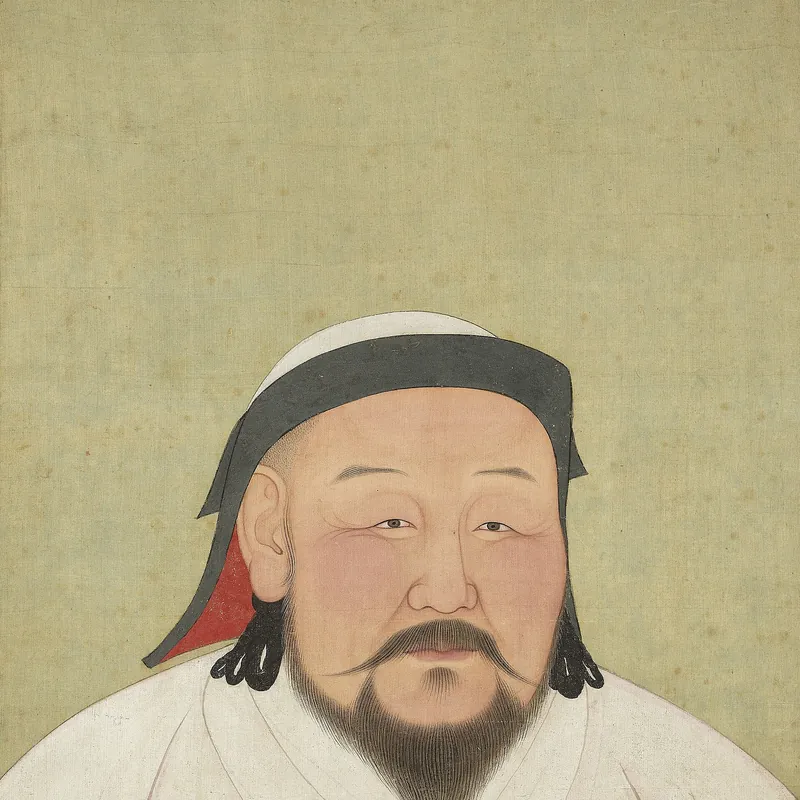
Under his heirs, Mongol rule reached from Korea and China to Russia, Persia and the edges of Europe. At its height in the late 13th century, the Mongol Empire was the largest contiguous land empire the world has ever known, though by then it had divided into four khanates: the Golden Horde, the Chagatai Khanate, the Ilkhanate and the Yuan dynasty.
After Genghis: Europe and the wider world
The Mongol invasion of Europe came after his death. In 1241, armies sent by Ögedei defeated Polish and German forces at Legnica and the Hungarian army at Mohi, and Mongol troops reached the edges of Austria. Then, news of Ögedei’s death reached the commanders, and the armies withdrew to settle the succession. Europe was never invaded on that scale again.
The connected world his empire created had a darker side too. Many historians link the spread of the Black Death in the 1340s to the trade and military routes that crossed the Mongol realms, carrying the plague from Central Asia towards the Black Sea and then into Europe and the Middle East. The same networks that carried silk, spices and ideas also carried disease.
Legacy: destroyer or connector?
| The destruction | The connections |
|---|---|
| Campaigns killed millions and devastated cities such as Merv and Bukhara | Unified trade routes across Eurasia, a period often called the Pax Mongolica |
| Irrigation systems in Central Asia and Persia were ruined, with long-term effects | Merchants, missionaries and travellers such as Marco Polo crossed Asia more safely |
| Conquered peoples were taxed heavily and sometimes enslaved | Ideas, technologies and goods moved between China, Persia and Europe |
| Remembered as a tyrant in Russia and the Arab world | Honoured as the founder of the nation in Mongolia |
Western scholarship since the 1990s has moved away from the old image of a simple barbarian warlord, emphasising his organisational genius, legal reforms and the trade networks his empire enabled. That reassessment has its critics, who warn against downplaying the scale of the killing. The fairest view is that both stories are true at once.
The genetic legacy
A widely cited 2003 genetic study found that about 8% of men in the regions of the former Mongol Empire, roughly 0.5% of men worldwide, carry a Y-chromosome lineage that appears to descend from a single man who lived around the time of Genghis Khan. The researchers suggested it may trace to Genghis and his male relatives, whose descendants ruled across Asia for generations. The link is a strong hypothesis rather than proven fact, but it is a striking illustration of his dynasty’s reach.
Genghis Khan in modern Mongolia
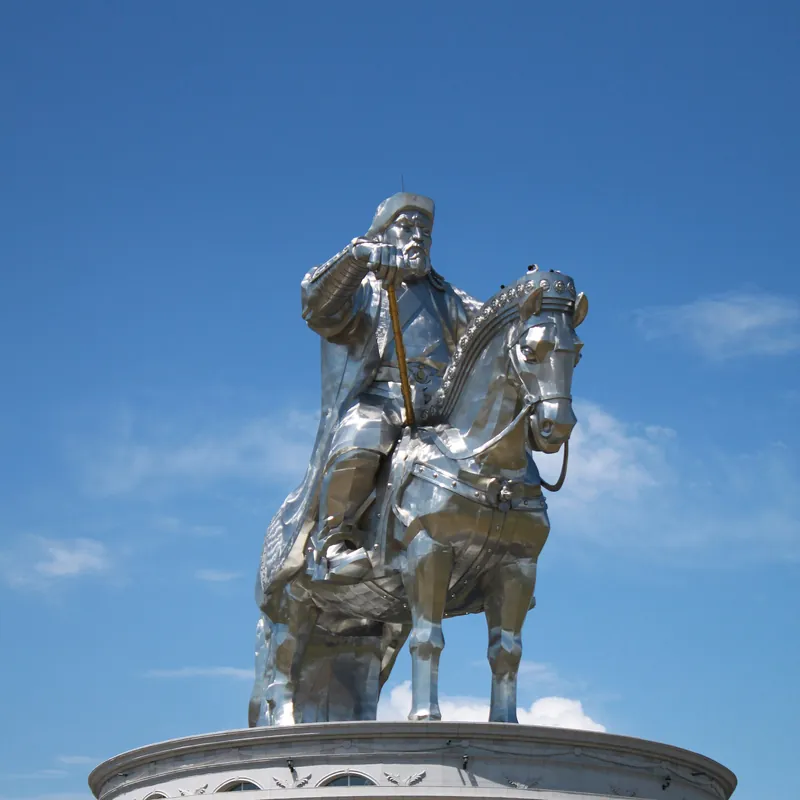
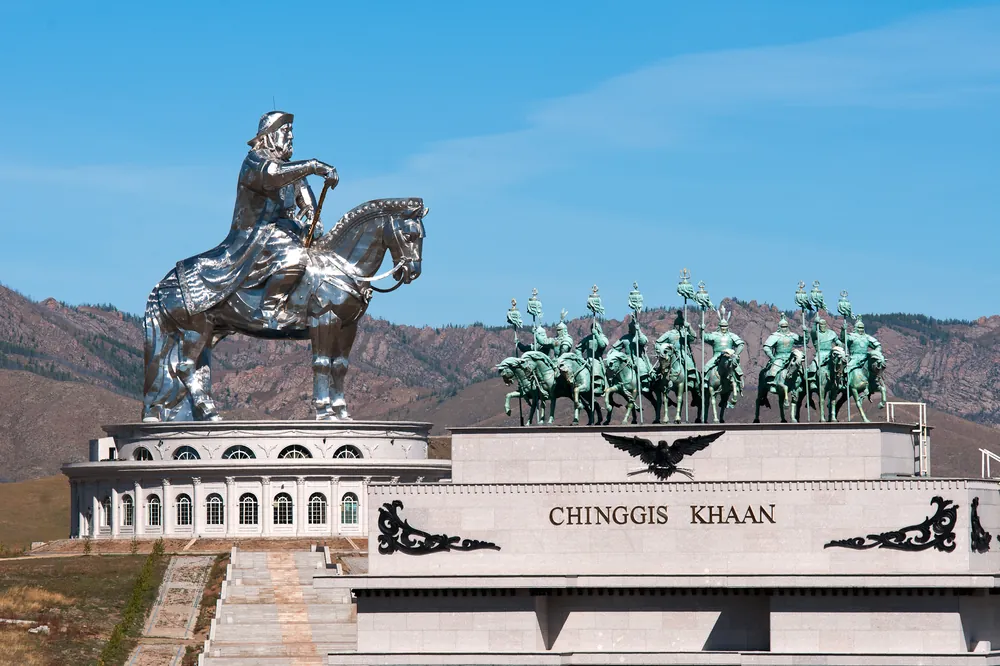
During the Soviet era, public celebration of Genghis Khan was discouraged in Mongolia. Since the democratic revolution of 1990, he has been embraced as the father of the nation. His image appears on Mongolian banknotes, the main international airport near Ulaanbaatar is named after him, and a 40-metre stainless-steel statue of him on horseback stands east of the capital, part of the Chinggis Khaan Statue Complex opened in 2008.
Visiting Genghis Khan’s Mongolia
For travellers, several places bring his story to life. The Chinggis Khaan Statue Complex is an easy day trip from Ulaanbaatar. Further north-east, in Khentii province, the sacred mountain of Burkhan Khaldun, which UNESCO inscribed on its World Heritage List in 2015 as part of a sacred landscape associated with Genghis Khan, is traditionally linked to his birth and burial. Ulaanbaatar’s museums, including the Chinggis Khaan National Museum, display artefacts from the Mongol Empire. Visiting during the Naadam festival in July adds horse racing, archery and wrestling, traditional skills celebrated since his time.
Myths and facts
| Myth | Fact |
|---|---|
| “Genghis Khan was his name” | He was born Temüjin; Genghis Khan was a title adopted in 1206. |
| “He conquered Europe” | Mongol armies reached Eastern Europe after his death, under Ögedei. |
| “He conquered all of China” | He conquered much of northern China; his grandson Kublai completed the conquest of China. |
| “His tomb is known” | His burial place has never been found. |
| “Mongols were just raiders” | He built a state with laws, a written script, a relay system and an administration. |
For more clear, sourced history, see our profiles of other figures in the History section as they are published, and for a lighter change of subject, our guide to learning Spanish fast covers another of the world’s great connectors: language.
More from our History section: José Martí, Thomas Jefferson, Elie Wiesel.
Frequently asked questions
Who was Genghis Khan?
The founder and first ruler of the Mongol Empire, born Temüjin around 1162, who united the Mongol tribes and conquered much of northern China and Central Asia.
What was Genghis Khan’s real name?
Temüjin. “Genghis Khan” was a title he adopted in 1206.
When did Genghis Khan die?
In August 1227 (the 18th or 25th), during a campaign against the Western Xia in north-west China.
How did Genghis Khan die?
The cause is uncertain; accounts mention a fall from his horse, illness or wounds.
Where is Genghis Khan buried?
Nobody knows. He was buried in secret, traditionally near the mountain Burkhan Khaldun in Mongolia.
How big was the Mongol Empire?
Under his successors it became the largest contiguous land empire in history, stretching from Korea and China to Eastern Europe and the Middle East.
Who succeeded Genghis Khan?
His third son, Ögedei, who became Great Khan in 1229.
Was Kublai Khan related to Genghis Khan?
Yes. Kublai was his grandson, the son of Tolui, and founded China’s Yuan dynasty.
Is it true many people descend from Genghis Khan?
A 2003 study found about 0.5% of men worldwide share a Y-chromosome lineage that may trace to him or his relatives; the link is a hypothesis.
Why is Genghis Khan controversial?
His conquests killed millions and devastated regions, but his empire also connected trade and cultures across Eurasia.
Final thoughts
Genghis Khan rose from an abandoned boy on the steppe to the founder of an empire that reshaped the world. He was a brilliant organiser and military leader, and also the architect of campaigns of terrible destruction. Understanding him means holding both truths at once, which is exactly why, eight centuries later, he remains one of history’s most debated figures.
Sources: Standard historical scholarship on Genghis Khan and the Mongol Empire, drawing on The Secret History of the Mongols and Persian and Chinese chronicles; Zerjal et al. (2003), “The Genetic Legacy of the Mongols”, American Journal of Human Genetics; information on the Chinggis Khaan Statue Complex (2008). Images: Wikimedia Commons, credited in each caption.