Short answer: the best-known Bible verses of praise are Psalm 150:6 (“Let every thing that hath breath praise the LORD”), Psalm 95:6 (“O come, let us worship and bow down”), Psalm 100:4, Psalm 34:1, Psalm 103:1, Hebrews 13:15 and John 4:23-24. Praise is telling God how great he is; worship is bowing your whole life before him. The Psalms are the Bible’s praise book, and their final five chapters (146-150) all begin and end with “Praise ye the LORD”.
Below are 45+ verses arranged by need: hard days, music, thanksgiving, mornings and evenings, everyday life and heaven’s worship. Each comes with a line on why it matters, plus a seven-day reading plan.
How we put this together (checked 26 November 2026): every verse is quoted word for word from the King James Version, the translation most readers recognise for these passages. Hebrew and Greek word meanings come from Strong’s Concordance numbering. If your church reads the NIV, ESV or NKJV, the wording will differ slightly, but the references are the same.
150
psalms in the Bible’s praise book
13
times “praise” appears in Psalm 150’s six verses (KJV)
5
books inside Psalms, each closing with a doxology
1
psalm titled “a psalm of praise”: Psalm 145
Some days the words come easily. Other days you want to thank God and find you have nothing to say. That is exactly why the Bible gives us its own words of praise: they were written by people who knew joy and grief, victory and fear, and still found reasons to lift their voice to God. This guide gathers the verses believers have leaned on for three thousand years and explains what each one actually means, so you can use them in church, in prayer or on an ordinary Tuesday.
Praise and worship: what is the difference?
People often say “praise and worship” as one phrase, and in practice the two belong together. But the Bible uses them slightly differently, and knowing the difference makes the verses richer.
Praise is outward and spoken. It declares who God is and what he has done, often loudly, often with music. You can praise God in a crowd of thousands or under your breath in traffic.
Worship is inward and surrendered. The main Old Testament word for it, shachah, literally means to bow down or lie face-down. Worship is the posture of the heart that praise flows from.
Thanksgiving sits between them. It looks back at specific things God has done and names them, which is why the Psalms so often pair “thanks” with “praise”.
Put simply: praise is what you say about God; worship is how you stand before him. Jesus put the emphasis on the heart when he said true worshippers “shall worship the Father in spirit and in truth” (John 4:23).
Word
What it means
Where you meet it
halal Hebrew, H1984
To praise, boast in, celebrate; the root of “Hallelujah”
Psalm 150:1, “Praise ye the LORD”
yadah Hebrew, H3034
To give thanks or acknowledge, linked to lifting the hands
Psalm 9:1, “I will praise thee”
towdah Hebrew, H8426
Thanksgiving; also a thank offering
Psalm 100:4, “with thanksgiving”
shabach Hebrew, H7623
To praise aloud, to commend
Psalm 63:3, “my lips shall praise thee”
barak Hebrew, H1288
To bless; the same root as “to kneel”
Psalm 103:1, “Bless the LORD”
zamar Hebrew, H2167
To sing praise, to make music
Psalm 92:1, “sing praises”
tehillah Hebrew, H8416
A song of praise; the Hebrew name of Psalms is Tehillim
Psalm 22:3, “the praises of Israel”
shachah Hebrew, H7812
To bow down, to worship
Psalm 95:6, “let us worship”
proskuneo Greek, G4352
To bow before, to worship
John 4:23-24
latreia Greek, G2999
Service offered to God
Romans 12:1, “reasonable service”
The Bible’s main words for praise and worship, with Strong’s numbers.
The 10 best-loved verses about praise and worship
If you only learn ten, learn these. Between them they cover why we praise, how we praise and what it does to us.
1. Psalm 150:6, the Bible’s last word on praise
“Let every thing that hath breath praise the LORD. Praise ye the LORD.”
Psalm 150:6 (KJV)
The very last verse of the Psalms widens the invitation to everything alive. If you have breath, you qualify.
2. Psalm 95:6-7, the classic call to worship
“O come, let us worship and bow down: let us kneel before the LORD our maker. For he is our God; and we are the people of his pasture, and the sheep of his hand.”
Psalm 95:6-7 (KJV)
Three verbs (worship, bow, kneel) show worship as posture as well as song. Churches have opened services with this psalm for centuries.
3. Psalm 100:4-5, how to come into God’s presence
“Enter into his gates with thanksgiving, and into his courts with praise: be thankful unto him, and bless his name. For the LORD is good; his mercy is everlasting; and his truth endureth to all generations.”
Psalm 100:4-5 (KJV)
Thanksgiving gets you through the gate; praise carries you into the courts. The reason is simple: the LORD is good.
4. Psalm 34:1-3, praise that does not depend on the day
“I will bless the LORD at all times: his praise shall continually be in my mouth. My soul shall make her boast in the LORD: the humble shall hear thereof, and be glad. O magnify the LORD with me, and let us exalt his name together.”
Psalm 34:1-3 (KJV)
David wrote this after escaping danger by pretending to be mad (see the psalm’s heading). “At all times” was not a figure of speech for him.
5. Psalm 103:1-2, talking to your own soul
“Bless the LORD, O my soul: and all that is within me, bless his holy name. Bless the LORD, O my soul, and forget not all his benefits.”
Psalm 103:1-2 (KJV)
Sometimes the person who most needs to hear your praise is you. “Forget not” is a command to remember.
6. John 4:23-24, the heart of true worship
“But the hour cometh, and now is, when the true worshippers shall worship the Father in spirit and in truth: for the Father seeketh such to worship him. God is a Spirit: and they that worship him must worship him in spirit and in truth.”
John 4:23-24 (KJV)
Jesus said this to a Samaritan woman arguing about which mountain was the right place to worship. His answer: not a place but a heart.
7. Hebrews 13:15, praise as an offering
“By him therefore let us offer the sacrifice of praise to God continually, that is, the fruit of our lips giving thanks to his name.”
Hebrews 13:15 (KJV)
Animal sacrifices are over, but this verse says believers still bring an offering: words of thanks, “continually”.
8. Romans 12:1, worship as a whole life
“I beseech you therefore, brethren, by the mercies of God, that ye present your bodies a living sacrifice, holy, acceptable unto God, which is your reasonable service.”
Romans 12:1 (KJV)
The Greek word behind “service” is latreia, worship. Paul says your body and your Monday-to-Saturday life are part of it.
9. Isaiah 25:1, praise for God’s faithfulness
“O LORD, thou art my God; I will exalt thee, I will praise thy name; for thou hast done wonderful things; thy counsels of old are faithfulness and truth.”
Isaiah 25:1 (KJV)
A prophet praises God for plans made “of old” that have now come true. Good for anyone looking back on answered prayer.
10. Revelation 4:11, the song of heaven
“Thou art worthy, O Lord, to receive glory and honour and power: for thou hast created all things, and for thy pleasure they are and were created.”
Revelation 4:11 (KJV)
The elders in John’s vision give the most basic reason for praise: God made everything.
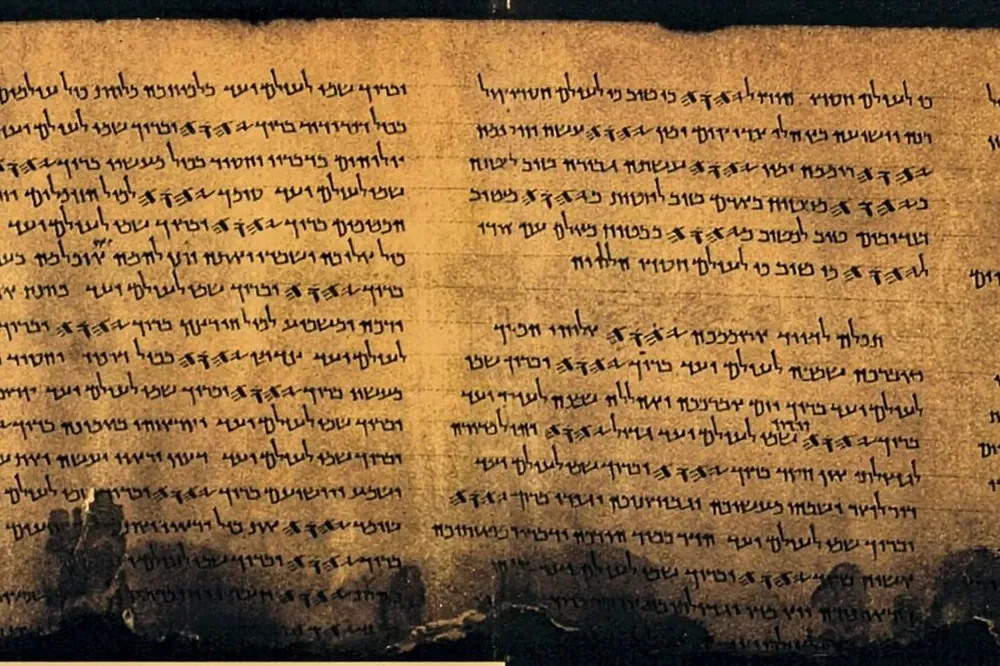
The Great Psalms Scroll (11Q5), found in Qumran Cave 11 in 1956 and dating to the first century AD. It holds around 50 compositions, mostly psalms, and is one of the oldest surviving copies of the Bible’s praise songs. (Photo: Unknown / Wikimedia Commons, Public domain)
Bible verses for praising God when life is hard
The Bible never pretends praise is easy. Some of its most powerful praise comes from people in prison, in grief or watching their livelihood fail. These verses are for those days.
“Although the fig tree shall not blossom, neither shall fruit be in the vines; the labour of the olive shall fail, and the fields shall yield no meat; the flock shall be cut off from the fold, and there shall be no herd in the stalls: Yet I will rejoice in the LORD, I will joy in the God of my salvation.”
Habakkuk 3:17-18 (KJV)
Crops failing, flocks gone, stalls empty: “Yet I will rejoice.” Habakkuk’s praise is a decision, not a feeling.
“And at midnight Paul and Silas prayed, and sang praises unto God: and the prisoners heard them.”
Acts 16:25 (KJV)
Paul and Silas had just been beaten and locked in stocks. They sang anyway, and the other prisoners were listening.
“And said, Naked came I out of my mother’s womb, and naked shall I return thither: the LORD gave, and the LORD hath taken away; blessed be the name of the LORD.”
Job 1:21 (KJV)
Spoken on the day Job lost his children and everything he owned. One of the hardest and most honest verses in Scripture.
“Why art thou cast down, O my soul? and why art thou disquieted within me? hope thou in God: for I shall yet praise him, who is the health of my countenance, and my God.”
Psalm 42:11 (KJV)
The psalmist argues with his own despair and wins: “I shall yet praise him.” Praise here is a statement of hope about the future.
“But thou art holy, O thou that inhabitest the praises of Israel.”
Psalm 22:3 (KJV)
Psalm 22 begins “My God, my God, why hast thou forsaken me?”, the words Jesus cried on the cross, yet in the same breath it calls God holy and enthroned on his people’s praise.
A gentle word: praising God in pain does not mean pretending you are fine. Many psalms of praise start as complaints (Psalms 13, 22 and 42 are good examples). Bring God the honest version of your day, then end where the psalmists end: with who he is.
Verses about praising God with music and song
From Miriam’s tambourine to the “new song” in Revelation, singing is the Bible’s favourite way to praise. These verses explain why music matters in worship.
“Praise ye the LORD. Praise God in his sanctuary: praise him in the firmament of his power. Praise him for his mighty acts: praise him according to his excellent greatness. Praise him with the sound of the trumpet: praise him with the psaltery and harp. Praise him with the timbrel and dance: praise him with stringed instruments and organs. Praise him upon the loud cymbals: praise him upon the high sounding cymbals.”
Psalm 150:1-5 (KJV)
Trumpet, psaltery, harp, timbrel, dance, strings, organs and cymbals. Psalm 150 is effectively a full orchestra pointed at God.
“Rejoice in the LORD, O ye righteous: for praise is comely for the upright. Praise the LORD with harp: sing unto him with the psaltery and an instrument of ten strings. Sing unto him a new song; play skilfully with a loud noise.”
Psalm 33:1-3 (KJV)
“Sing unto him a new song; play skilfully.” Skill and fresh songs both honour God.
“Speaking to yourselves in psalms and hymns and spiritual songs, singing and making melody in your heart to the Lord; Giving thanks always for all things unto God and the Father in the name of our Lord Jesus Christ.”
Ephesians 5:19-20 (KJV)
Psalms, hymns and spiritual songs: the early church sang old and new together, and to each other as well as to God.
“Let the word of Christ dwell in you richly in all wisdom; teaching and admonishing one another in psalms and hymns and spiritual songs, singing with grace in your hearts to the Lord. And whatsoever ye do in word or deed, do all in the name of the Lord Jesus, giving thanks to God and the Father by him.”
Colossians 3:16-17 (KJV)
Singing is also teaching. The songs a church sings shape what it believes.
“Sing unto the LORD, all the earth; shew forth from day to day his salvation. Declare his glory among the heathen; his marvellous works among all nations. For great is the LORD, and greatly to be praised: he also is to be feared above all gods.”
1 Chronicles 16:23-25 (KJV)
Part of the song David appointed when the Ark came to Jerusalem: praise that tells the nations what God has done.
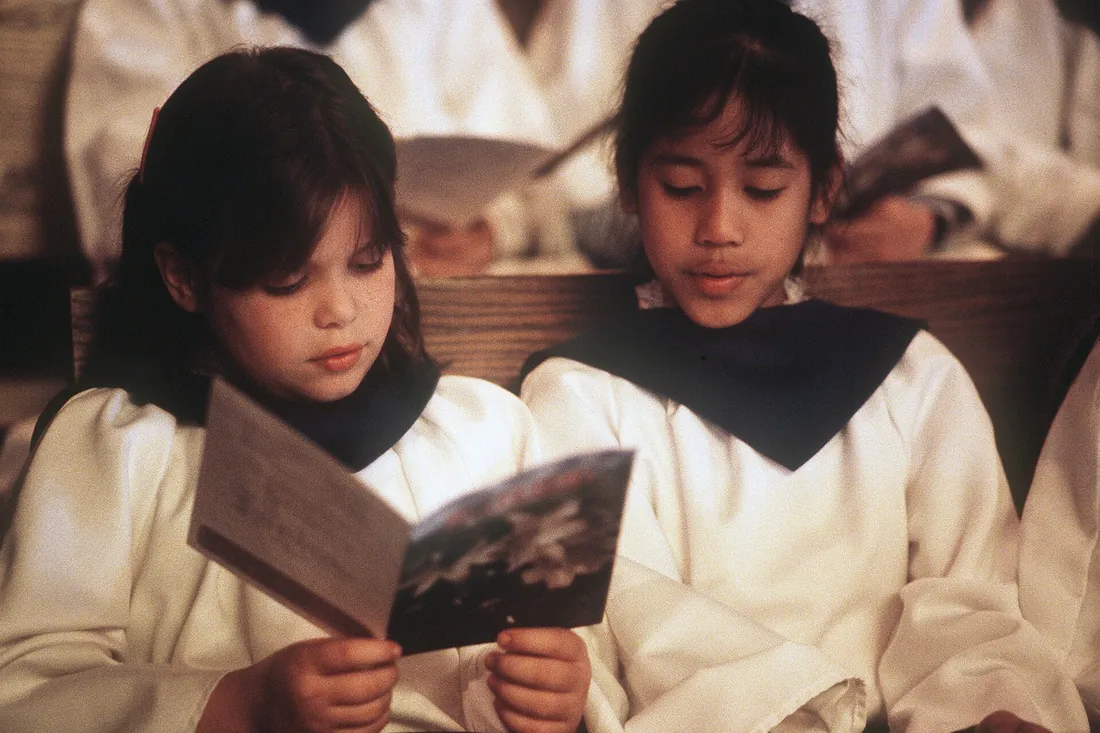
Young choir members singing a hymn at an Easter Sunday service in the North Chapel at Naval Amphibious Base Little Creek, Virginia. Singing has been at the centre of Christian worship since the first churches. (Photo: Department of Defense. American Forces Information Service. / Wikimedia Commons, Public domain)
Bible verses of thanksgiving and praise
Thanksgiving is praise with specifics. These verses are good for grace before meals, Thanksgiving Day services and any moment you want to say thank you.
“O give thanks unto the LORD, for he is good: for his mercy endureth for ever.”
Psalm 107:1 (KJV)
This line repeats across Psalms 106, 107, 118 and 136. It was clearly a refrain everyone knew.
“O give thanks unto the LORD; for he is good: for his mercy endureth for ever.”
Psalm 136:1 (KJV)
Psalm 136 repeats “for his mercy endureth for ever” in all 26 verses, a call-and-response song for a whole congregation.
“Rejoice evermore. Pray without ceasing. In every thing give thanks: for this is the will of God in Christ Jesus concerning you.”
1 Thessalonians 5:16-18 (KJV)
“In every thing”, not “for every thing”. Paul does not ask you to be grateful for evil, but to stay thankful through it.
“I will praise thee, O LORD, with my whole heart; I will shew forth all thy marvellous works. I will be glad and rejoice in thee: I will sing praise to thy name, O thou most High.”
Psalm 9:1-2 (KJV)
“With my whole heart” rules out half-hearted praise. Notice the plan: praise, then tell, then rejoice, then sing.
“And Mary said, My soul doth magnify the Lord, And my spirit hath rejoiced in God my Saviour.”
Luke 1:46-47 (KJV)
The opening of Mary’s song, the Magnificat, sung by a young woman who had just heard she would carry the Messiah.
Morning and evening verses of praise
The Psalms suggest bookending the day with praise. Read one of these when you wake and one before you sleep.
“It is a good thing to give thanks unto the LORD, and to sing praises unto thy name, O most High: To shew forth thy lovingkindness in the morning, and thy faithfulness every night.”
Psalm 92:1-2 (KJV)
Lovingkindness in the morning, faithfulness at night: one quality to expect, one to look back on.
“From the rising of the sun unto the going down of the same the LORD’S name is to be praised.”
Psalm 113:3 (KJV)
Psalm 113 opens the Hallel, the psalms sung at Passover. Sunrise to sunset covers the whole day and the whole earth.
“Because thy lovingkindness is better than life, my lips shall praise thee. Thus will I bless thee while I live: I will lift up my hands in thy name.”
Psalm 63:3-4 (KJV)
Written in the wilderness of Judah. “Better than life” is a bold claim from someone who was running for his life.
“Praise ye the LORD. Praise the LORD, O my soul. While I live will I praise the LORD: I will sing praises unto my God while I have any being.”
Psalm 146:1-2 (KJV)
A lifelong promise: “while I have any being.” Psalm 146 begins the five Hallelujah psalms that close the book.
“Let my mouth be filled with thy praise and with thy honour all the day.”
Psalm 71:8 (KJV)
Psalm 71 is a prayer of someone growing old. Praise “all the day” is not only for the young and energetic.
Worship in everyday life: verses beyond Sunday
The New Testament stretches worship far beyond a church building. These verses turn ordinary work, meals and conversations into worship.
“Whether therefore ye eat, or drink, or whatsoever ye do, do all to the glory of God.”
1 Corinthians 10:31 (KJV)
Eating and drinking are about as ordinary as it gets. Paul says even those can glorify God.
“But ye are a chosen generation, a royal priesthood, an holy nation, a peculiar people; that ye should shew forth the praises of him who hath called you out of darkness into his marvellous light.”
1 Peter 2:9 (KJV)
Every believer is part of a “royal priesthood” whose job description is to show forth God’s praises.
“Give unto the LORD the glory due unto his name; worship the LORD in the beauty of holiness.”
Psalm 29:2 (KJV)
“The beauty of holiness”: worship is a response to God’s character, not only to what he gives us.
“Rejoice in the Lord alway: and again I say, Rejoice.”
Philippians 4:4 (KJV)
Written from prison. Paul repeats himself because he knew how easily joy slips.
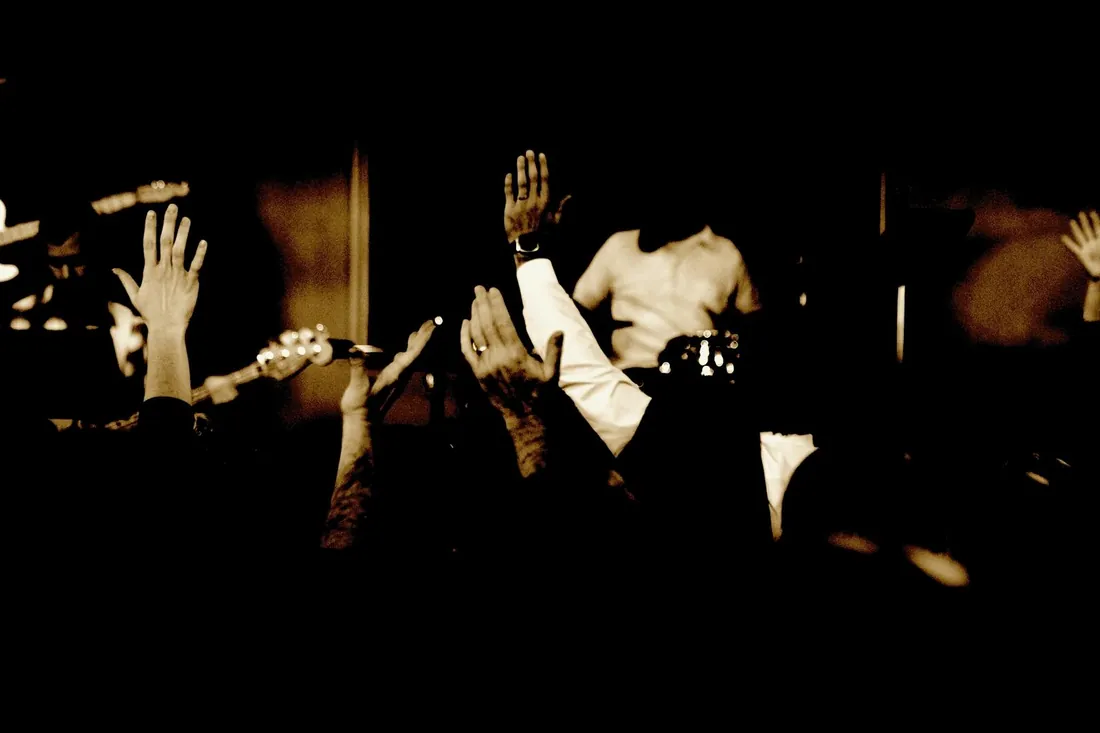
Worship at Grace Evangelical Free Church of La Mirada, California. Raised hands echo yadah, the Hebrew word for praise linked to lifting the hands. (Photo: Brian A. Petersen / Wikimedia Commons, CC BY-SA 2.0)
Praise in heaven: worship verses from Revelation
The Bible ends with worship. In John’s vision, every creature in heaven and earth joins one song, a reminder that the praise we offer now is rehearsal for what is coming.
“Saying with a loud voice, Worthy is the Lamb that was slain to receive power, and riches, and wisdom, and strength, and honour, and glory, and blessing. And every creature which is in heaven, and on the earth, and under the earth, and such as are in the sea, and all that are in them, heard I saying, Blessing, and honour, and glory, and power, be unto him that sitteth upon the throne, and unto the Lamb for ever and ever.”
Revelation 5:12-13 (KJV)
Seven words of honour for the Lamb, then every creature everywhere joins in. It is the largest choir in Scripture.
“Saying, Amen: Blessing, and glory, and wisdom, and thanksgiving, and honour, and power, and might, be unto our God for ever and ever. Amen.”
Revelation 7:12 (KJV)
Another sevenfold blessing, framed by two Amens. Many churches still use it as a closing doxology.
“Now unto him that is able to keep you from falling, and to present you faultless before the presence of his glory with exceeding joy, To the only wise God our Saviour, be glory and majesty, dominion and power, both now and ever. Amen.”
Jude 1:24-25 (KJV)
One of the Bible’s best-loved benedictions, praising God who is “able to keep you from falling”.
The word “Hallelujah” (Hebrew halelu, “praise ye”, plus Yah, short for God’s name) appears in the New Testament only in Revelation 19, where the King James Version spells it “Alleluia” four times (verses 1, 3, 4 and 6).
How the Book of Psalms is built around praise
The Psalms are not a random songbook. (For the best praise psalms one by one, see our guide to psalms of praise.) They are arranged in five books, and each one closes with a doxology, a short burst of praise ending in “Amen”. The whole collection then finishes with five psalms of pure praise, as if the book itself is moving from lament towards praise.
The five books of Psalms and the praise that closes each one
Bar length = number of psalms in each book.
Book I Psalms 1-41
Ends: “Blessed be the LORD God of Israel from everlasting, and to everlasting. Amen, and Amen.” (41:13)
Book II Psalms 42-72
Ends: “let the whole earth be filled with his glory; Amen, and Amen.” (72:19)
Book III Psalms 73-89
Ends: “Blessed be the LORD for evermore. Amen, and Amen.” (89:52)
Book IV Psalms 90-106
Ends: “let all the people say, Amen. Praise ye the LORD.” (106:48)
Book V Psalms 107-150
Ends with five Hallelujah psalms (146-150); Psalm 150 is the doxology of the whole book.
The Hallel (Psalms 113-118) was sung at the great Jewish festivals, especially Passover. Many scholars believe the “hymn” Jesus and his disciples sang after the Last Supper (Matthew 26:30) came from these psalms.
The Hallelujah psalms (146-150) each begin and end with “Praise ye the LORD”, Hebrew Hallelu-Yah.
Psalm 145 is the only psalm whose heading calls it a tehillah, “a psalm of praise”. It is also an acrostic: each verse begins with the next letter of the Hebrew alphabet. One letter (nun) is missing from the standard Hebrew text, but the Great Psalms Scroll pictured above includes a line for it.
Psalm 136 repeats the same refrain in every verse, which suggests it was sung responsively, with a leader and a congregation answering.
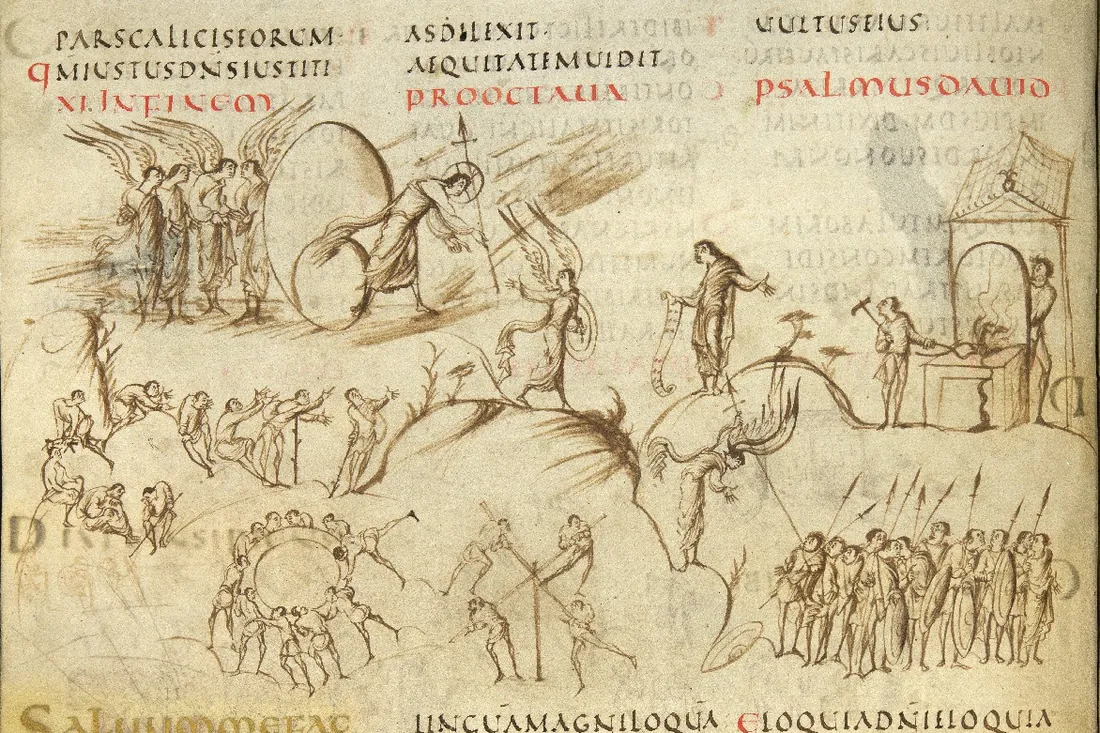
A page of the Utrecht Psalter, made by Carolingian monks around 820. Every psalm in it is illustrated with lively pen drawings that act out the words, an early example of how seriously the church took praying the Psalms. (Photo: Unknown monks c. 800 / Wikimedia Commons, Public domain)
How to use these verses: church, prayer and memory
In a church service
Many services open with a call to worship: a leader reads a verse and the congregation responds. A simple version using Psalm 95 and Psalm 100 is below; for 17 more, covering every season from Advent to Pentecost, see our guide to call to worship verses and examples.
Leader: O come, let us worship and bow down: let us kneel before the LORD our maker.
People: For he is our God; and we are the people of his pasture, and the sheep of his hand.
Leader: Enter into his gates with thanksgiving, and into his courts with praise.
All: For the LORD is good; his mercy is everlasting; and his truth endureth to all generations.
In personal prayer: praying a psalm in four steps
Read it slowly, out loud if you can. The Psalms were written to be heard.
Notice one line that stands out to you today. Do not rush to the end.
Turn it into your own words. “Bless the LORD, O my soul” becomes “Lord, I want to thank you for…” and then name something specific.
Finish with the verse itself, so your prayer ends on Scripture rather than on your worries.
Start with short ones: Psalm 150:6, Psalm 113:3, Psalm 145:3 and Philippians 4:4 are all a single line. Write one on a card, read it at every meal for a week, and you will have it for life. The longer passages (Psalm 100, Psalm 103:1-5) come easily once the habit is there.
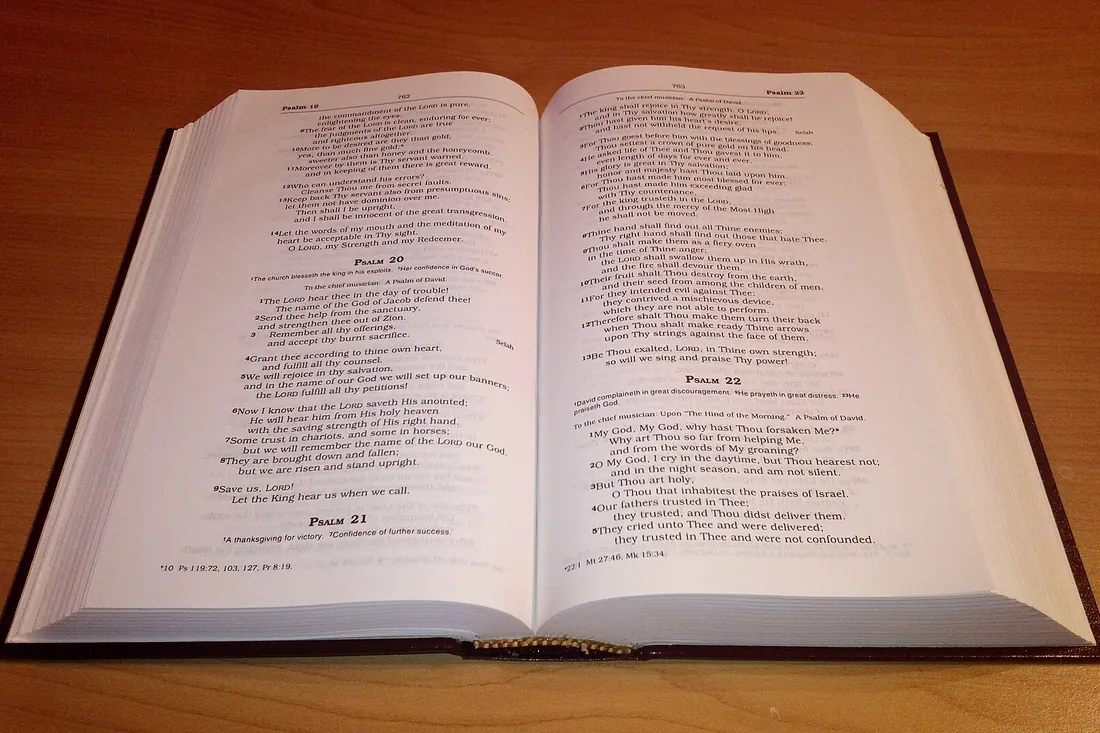
An open Bible at the Psalms. Reading one psalm a day takes you through all 150 in five months. (Photo: Veverve / Wikimedia Commons, CC BY-SA 4.0)
More verses of praise to keep close
Verse
Words (KJV)
Exodus 15:2
The LORD is my strength and song, and he is become my salvation: he is my God, and I will prepare him an habitation; my father’s God, and I will exalt him.
2 Samuel 22:4
I will call on the LORD, who is worthy to be praised: so shall I be saved from mine enemies.
Psalm 8:1
O LORD our Lord, how excellent is thy name in all the earth! who hast set thy glory above the heavens.
Psalm 96:9
O worship the LORD in the beauty of holiness: fear before him, all the earth.
Psalm 145:3
Great is the LORD, and greatly to be praised; and his greatness is unsearchable.
Psalm 147:1
Praise ye the LORD: for it is good to sing praises unto our God; for it is pleasant; and praise is comely.
Isaiah 12:4-5
And in that day shall ye say, Praise the LORD, call upon his name, declare his doings among the people, make mention that his name is exalted. Sing unto the LORD; for he hath done excellent things: this is known in all the earth.
Daniel 2:20
Daniel answered and said, Blessed be the name of God for ever and ever: for wisdom and might are his.
Luke 19:37-38
And when he was come nigh, even now at the descent of the mount of Olives, the whole multitude of the disciples began to rejoice and praise God with a loud voice for all the mighty works that they had seen; Saying, Blessed be the King that cometh in the name of the Lord: peace in heaven, and glory in the highest.
Psalm 41:13
Blessed be the LORD God of Israel from everlasting, and to everlasting. Amen, and Amen.
Ten more verses for prayer, cards and services.
Frequently asked questions
What is the most powerful Bible verse about praise?
Many believers point to Psalm 150:6, “Let every thing that hath breath praise the LORD,” because it is the final verse of the Psalms and includes everyone. Others choose Habakkuk 3:17-18 or Acts 16:25, which show praise in the hardest circumstances.
What is the difference between praise and worship in the Bible?
Praise declares who God is and what he has done, usually out loud and often with music. Worship is the inner posture of bowing before God; the main Hebrew word, shachah, means to bow down. Praise is something you do; worship is how you stand before God.
Which psalm is called a psalm of praise?
Psalm 145 is the only psalm whose heading calls it a tehillah, “a psalm of praise”. The Hebrew name for the whole Book of Psalms, Tehillim, comes from the same word.
How many times is praise mentioned in Psalm 150?
In the King James Version the word “praise” appears 13 times in Psalm 150’s six verses, more densely than anywhere else in the Bible.
What does Hallelujah mean?
Hallelujah joins two Hebrew words: halelu, “praise ye”, and Yah, a short form of God’s name. It means “Praise ye the LORD”, which is how the King James Version translates it in the Psalms. In Revelation 19 it is spelled Alleluia.
What verse says to praise God in all circumstances?
Psalm 34:1 says, “I will bless the LORD at all times: his praise shall continually be in my mouth.” 1 Thessalonians 5:18 adds, “In every thing give thanks: for this is the will of God in Christ Jesus concerning you.”
What is a good Bible verse to open a worship service?
Psalm 95:6, “O come, let us worship and bow down: let us kneel before the LORD our maker,” and Psalm 100:4, “Enter into his gates with thanksgiving,” are the most widely used calls to worship.
What does it mean that God inhabits the praises of his people?
The phrase comes from Psalm 22:3, “thou art holy, O thou that inhabitest the praises of Israel.” The Hebrew pictures God enthroned on, or seated upon, his people’s praises: their worship honours him as King.
Which psalms are the Hallel psalms?
Psalms 113 to 118 are known as the Hallel, sung at Jewish festivals such as Passover. Psalms 146 to 150 are sometimes called the final Hallel because each begins and ends with “Praise ye the LORD”.
Can I praise God without singing?
Yes. The Bible describes praise through spoken words (Psalm 34:1), thanksgiving (Hebrews 13:15), raised hands (Psalm 63:4), bowing (Psalm 95:6) and an obedient life (Romans 12:1). Singing is one beautiful way among many.
Final thoughts
Praise is not reserved for people who feel joyful. The Bible’s praise was written by shepherds and kings, prisoners and prophets, people who had lost everything and people who had just been rescued. If you are not sure where to begin, start with one line: “Bless the LORD, O my soul.” Say it in the morning, read Psalm 150 at night, and let the words of Scripture carry you on the days your own words run out.
Sources: Scripture quotations from the King James Version (Authorized Version). Hebrew and Greek word numbers from Strong’s Exhaustive Concordance. Background on the Great Psalms Scroll (11Q5) from the Israel Antiquities Authority’s Leon Levy Dead Sea Scrolls Digital Library. Utrecht Psalter: Utrecht University Library. Images: Wikimedia Commons, credited in each caption.